
In the Philippines, a festival is rarely only a parade. It is also a schedule: who’s coming home, where the food stalls will line up, which band will play, and which court will host the loudest game of the week. The modern layer is digital. Group chats share clips, live updates, and even screenshots from online betting sites as a quick way to compare public expectations with what fans feel in their bones, while the core remains the same. It’s community, pride, and the joy of competition.
When the fiesta becomes a scoreboard
Across the archipelago, fiesta weeks often pull sports into the celebration. Basketball is the easiest fit: one ball, one rim, and enough neighbors to make a crowd. A barangay tournament can sit beside a religious procession or a street dance competition without feeling out of place, because both are public rituals. One honors tradition through movement; the other honors it through effort.
For visitors, this is the magic of Filipino sports culture. You can eat a local delicacy, watch a dance troupe, then hear the squeak of shoes and follow the sound to a covered court where a rivalry game is unfolding like a family drama. When the final horn sounds, everyone returns to the festival streets, carrying the win or the loss loudly, humorously, and together.
January’s Santo Niño circuit
January is the season when devotion and celebration travel the same roads. Sinulog is held in Cebu City on the third Sunday of January; Ati-Atihan reaches its biggest celebration in Kalibo on the same day; and Dinagyang fills Iloilo City on the fourth Sunday of January. These festivals draw huge crowds for processions and street dancing, and they also create a natural stage for local sports energy: watch parties, friendly games, and conversations that stretch from the basilica steps to the nearest court.
During these weekends, basketball becomes the glue between visitors and locals. Even people who came for the parade will ask who is playing that night. Even people who went for the game will pause for the drums. The point is not to mix everything into one blur; it is to let the country’s two favorite forms of public emotion stand side by side.
Masks, flowers, and harvest
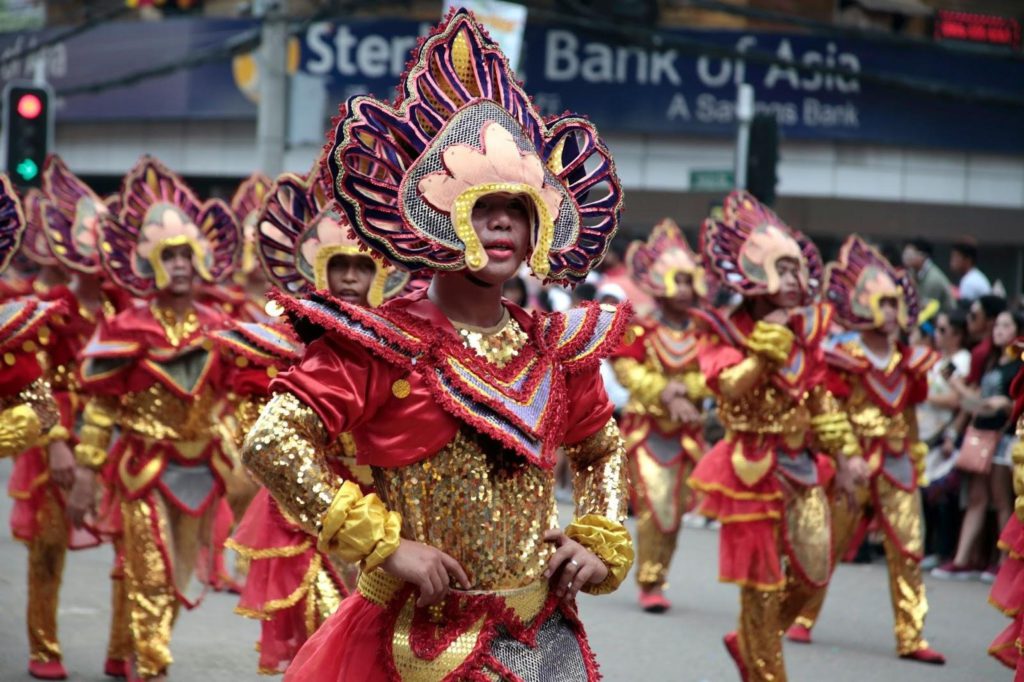
The festival calendar keeps turning, and sports keep following it. Panagbenga, the Baguio Flower Festival, runs from February through early March, transforming the city into a moving garden of floats and street dancing. Pahiyas is celebrated every May 15 in Lucban, Quezon, with houses decorated with produce and kiping. Kadayawan, observed in Davao City during the third week of August, is a thanksgiving celebration. MassKara, with its iconic smiling masks, has its highlights on the third Sunday of October in Bacolod.
In each setting, local competition feels natural. A tournament can raise funds for a barangay project, provide young players with a stage, and draw crowds that also purchase snacks, drinks, and small crafts. Sports tourism here is not only about big arenas; it’s about showing up in the middle of a town’s proud week and letting the atmosphere teach you how Filipinos socialize.
The neighborhood tournament
Festival sports is also economics in plain sight. The court becomes a marketplace: grilled food, cold drinks, small vendors selling jerseys or flags, tricycles shuttling people between venues, and local eateries catching the postgame surge. A tight game extends the evening, and an extended evening means more foot traffic for small businesses.
This is why basketball and festivals pair so well. Both are designed to gather people. Both reward participation. Both create stories that are sometimes retold with laughter, sometimes with a grudge, and often as a plan to return next year.
Pro leagues, regional leagues, and the online crowd
The country’s big leagues amplify the same community instincts. The PBA, founded in 1975, is widely cited as the first professional basketball league in Asia, and its biggest matchups become national conversations even when fans are far from the venue. MPBL, founded by Manny Pacquiao in 2017, leverages regional identity, with teams tied to local communities and a strong presence on Facebook and YouTube.
When festival weeks overlap with marquee games, digital platforms do what they do best: they connect scattered crowds. People stream on their phones, share highlights, post real-time reactions, and post festival photos. The result is a modern Filipino double-life: dancing and drumming in the street, then checking a box score on the walk home.
Odds talk as a new kind of pre-game chatter
Odds have become part of the online conversation because they condense a lot into a single number. Many fans treat PBA odds or MPBL odds like another reference point alongside injuries, travel, recent form, and matchup history. Used responsibly, it is closer to analytics than to bravado.
In the middle of a festival week, that kind of shorthand helps people stay connected. Someone posts a lineup update, someone posts a clip of last night’s best possession, and someone checks sports betting Philippines markets as a way to see how public expectations are shifting. On platforms that publish lines, including MelBet, those numbers can spark debate without replacing the basketball itself, especially when communities keep clear boundaries: fixed budgets for entertainment, no chasing losses, and no pretending a line is a prophecy.
The parade ends, the conversation doesn’t
A Filipino festival has a way of lingering. Even after the last float passes, the music stays in your head, and the best moments get replayed on screens. Basketball does the same. A great game becomes a story told at breakfast, then posted at lunch, then argued about at night.
Some fans wind down after a long day of dancing, watching, and scrolling by switching to lighter digital entertainment, and an online casino session can sit in that downtime as long as it stays firmly bounded by time and budget. The real win, though, is bigger than any screen: festivals and sports keep teaching the same lesson-community is something you build by showing up, cheering with your neighbors, and carrying the shared memory into the next season.

